
Communications
Every channel, one history
The phone system, the contact centre, and the work between them. Ericom designs and integrates both, operates the contact centre, and takes on what neither product does on its own: identity, carrier, routing and the customer record, so the conversation arrives with its history and leaves one behind.
Three conversations
To your customer it is one conversation. To your systems it is three: a chat session, a call and an email, each landing somewhere different and none of them aware of the others.
So the customer repeats themselves, and your team works without the context that would have let them resolve it the first time. Every measure you have looks fine. Calls are answered, emails are cleared, chat is staffed, and every report is accurate for its own channel. The handoff from one channel to the next is where the time and the goodwill went, and no report has a column for it.
The same gap runs through ordinary telephony. A call reaches reception with no sign of the emails that preceded it, and the after-hours announcement was written for a team that has since changed. Each system is doing what it was configured to do. None was configured to know about the others.
What we run
Two services, and the choice is about who is answering. Cloud Calling is the business phone system for the whole organisation. The contact centre is for the teams whose job is the queue, and the two run on one number plan.
- Teams Phone, carried by Telstra Cloud Calling Microsoft Teams Phone on Telstra Operator Connect. Your numbers move to the Microsoft tenancy you already own, calls route over Telstra, and the phone system is administered from the Teams admin centre instead of a box in a comms room. Ericom raises the Telstra paperwork, ports the numbers, designs the call flows and hands over to whoever runs it afterwards, which can be Ericom.
-
 From five seats to a thousand
Cloud Contact Centre
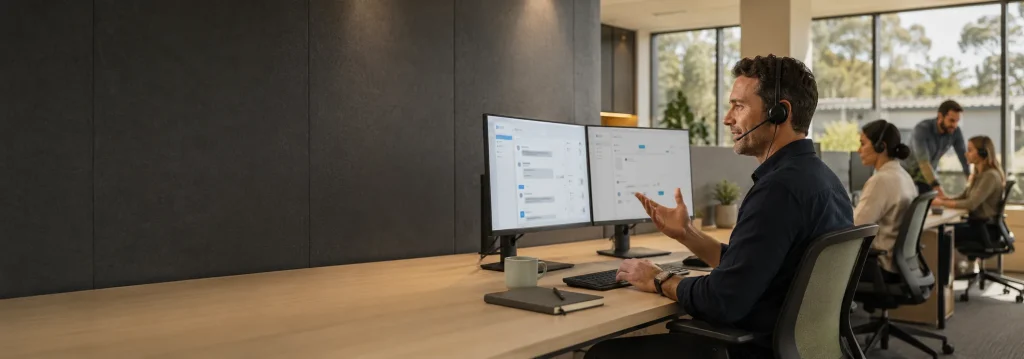
A customer starts on chat, rings when it stalls, then emails because the call was not returned, and explains themselves three times. A cloud contact centre puts every channel in one place with the history attached. Ericom designs it, integrates it with the systems you already run, and operates it.
From five seats to a thousand
Cloud Contact Centre
A customer starts on chat, rings when it stalls, then emails because the call was not returned, and explains themselves three times. A cloud contact centre puts every channel in one place with the history attached. Ericom designs it, integrates it with the systems you already run, and operates it.
The joins are the product
Nothing here is difficult on its own. A phone system works, a chat widget works, a case system works. Unified communications puts them on one platform, which is where most projects stop. What fails is the space between them, and that space is not owned by any of the vendors who sold you the pieces.
Ericom takes it on as scope. The call flows, the integrations and the reporting are designed and built by Ericom's own engineers, and the carrier is dealt with by Ericom. The contact centre is operated afterwards by the people who built it; calling is supported the same way where Ericom runs it after the project, under a separate agreement. Where that is the arrangement, a fault that crosses from carrier to platform to customer record is raised once and worked across all three.

“I can honestly say that I have never encountered such a quality technology partner in a system implementation before. You are responsive and deliver quality solutions and I would be happy to recommend you to other potential customers.”
Manager Customer Experience, Shoalhaven City Council
Common questions
Short answers first.
Does this have to run on Telstra?
It depends which service. Cloud Calling is Microsoft Teams Phone carried on Telstra Operator Connect, so for calling the answer is yes, and Ericom holds the Telstra relationship. The contact centre is a platform, not a carriage service. The voice path into it is integrated and managed by Ericom, and the carriage behind it can be Telstra or the carrier you already use.
How small can it start?
From a handful of contact centre seats, and a twenty person office is a normal calling project. The design work is the same shape at five seats as at five hundred, which is usually the surprise: the licences scale smoothly and the integration is what takes the time either way. Projects run from Wollongong, Sydney and Melbourne.
What about our existing phone system?
It depends what it is, how much life is left in it, and what is attached to it. Lift and emergency phones, alarm lines, radios and number ranges all have to move with it, and they decide the size of the job more than the headcount does. Replacing a working system for features the organisation has not asked for is a bad trade, and we would rather say so during scoping than after a migration.
Tell us where the conversation breaks
Tell us which team you are trying to fix, what a customer has to say twice to reach them, and what the phone bill says you are paying for. From those we can tell you whether the gap is in the calling, in the contact platform or between the two, and what a first phase would involve before anybody talks about licences.
Book a workshop