
Vital Signs Monitoring
Predictive, not detective
Contactless radar in every room, a personal baseline for every person, and a signal that arrives up to seven days before clinical presentation. Remote monitoring for residential aged care and hospital settings, with deployments in corrections.
Powered by Xandar Kardian
The costliest moments happen at night
Clinical deterioration shows up in the vital signs first. Changes in heart rate, respiratory rate and movement can be early indicators of UTIs, infection and other physiological issues. Those changes are too subtle to identify on a round, and they unfold between observations, when clinical cover is thinnest.
The cost is not only the ambulance. It is the resident who comes back having lost confidence, the staff who absorb that, and the acuity that AN-ACC does not see because it was not observed.
The same gap, six settings
The pressure above is residential aged care. The gap it describes exists anywhere people are checked on a schedule and unobserved between checks.
-
Residential aged care
Falls happen at night when staffing is lowest, and deterioration shows in the vital signs days before an acute event. Continuous oversight with no wearables and no cameras is less intrusive than a sitter or a camera in the room.
-
Hospitals and local health districts
Observations every four hours leave three and a half hours of blind time. Continuous monitoring stops at step-down, which is where residual risk is highest.
-
Corrections
Welfare checks are interval-based and miss what happens between them. Cameras and worn devices are not viable in a cell. Live in a corrective services environment since 2022.
-
Mental health
Inpatient settings need observation that does not escalate distress. Sitter watch and one-to-one monitoring are resource-intensive and hard to sustain.
-
Aged care at home
High-acuity clients are unmonitored for 23 hours or more between visits, and wearables do not work for people with cognitive impairment.
-
Retirement villages
Residents decline in their own unit, where the operator carries the duty of care but has no clinical alarm.
The POBC signal
Probability of Baseline Change compares each person's recent observations against their own established baseline. When the trend shifts in a statistically meaningful way, the platform raises a probability score, often days before a routine round would pick anything up. It is a prompt to review, not an alarm.
Up to 7 days of warning before clinical presentation.
up to 50% fewer resident falls Single-site pilot, April to June 2026. Indicative figures, hand-counted.
How it works
-
Sense
A contactless radar sensor in the room continuously measures heart rate, respiratory rate and movement. No wearables, no cameras, no interaction required.
-
Baseline
The platform builds a personal baseline over the first one to two weeks, learning what normal looks like for this person.
-
Score
POBC compares short-window observations against that baseline and puts a probability score on the clinical dashboard for the morning review.
What it is, and what it is not
The fastest way to understand Vital Signs Monitoring is to be clear about what it does not replace. It sits above your existing stack. Everything already on your floor stays exactly where it is.
What it does
-
Predicts deterioration
Flags a person whose physiology is moving away from their own baseline, often days before it would show on a round.
-
Builds a personal baseline
Learns what normal looks like for each person, then watches for movement away from it.
-
Prompts clinical review
Gives the team a daily prioritised list of who warrants attention this morning.
-
Builds an evidence trail
Every observation captured automatically and time-stamped, ready for clinical governance and post-incident review.
-
Thresholds as well as trend
High and low thresholds for heart rate and respiratory rate can be set per device, so per bed and per person. A reading outside someone's configured range triggers straight away, alongside the days-ahead trend signal.
What it does not do
-
Not a fall detector
It does not detect the moment a fall occurs. Its part is upstream: a quiet decline often comes before a fall, and a flagged decline gives the team a reason to review the resident first.
-
Not a nurse-call replacement
Existing nurse-call and emergency response workflows remain exactly as they are. Neither the trend signal nor a threshold alert replaces them; each starts the response you already have.
-
Not a diagnosis
POBC is a probability score. It is read alongside clinical assessment and does not stand in for it.
-
Not predictive on day one
The POBC signal matures once a personal baseline is established, typically after the first one to two weeks. Threshold alerts work from the first night.
-
Not aged care management software
It does not manage care plans, rosters, medication or billing. Vital Signs Monitoring runs alongside your residential aged care software and feeds it a clinical signal it does not otherwise have.
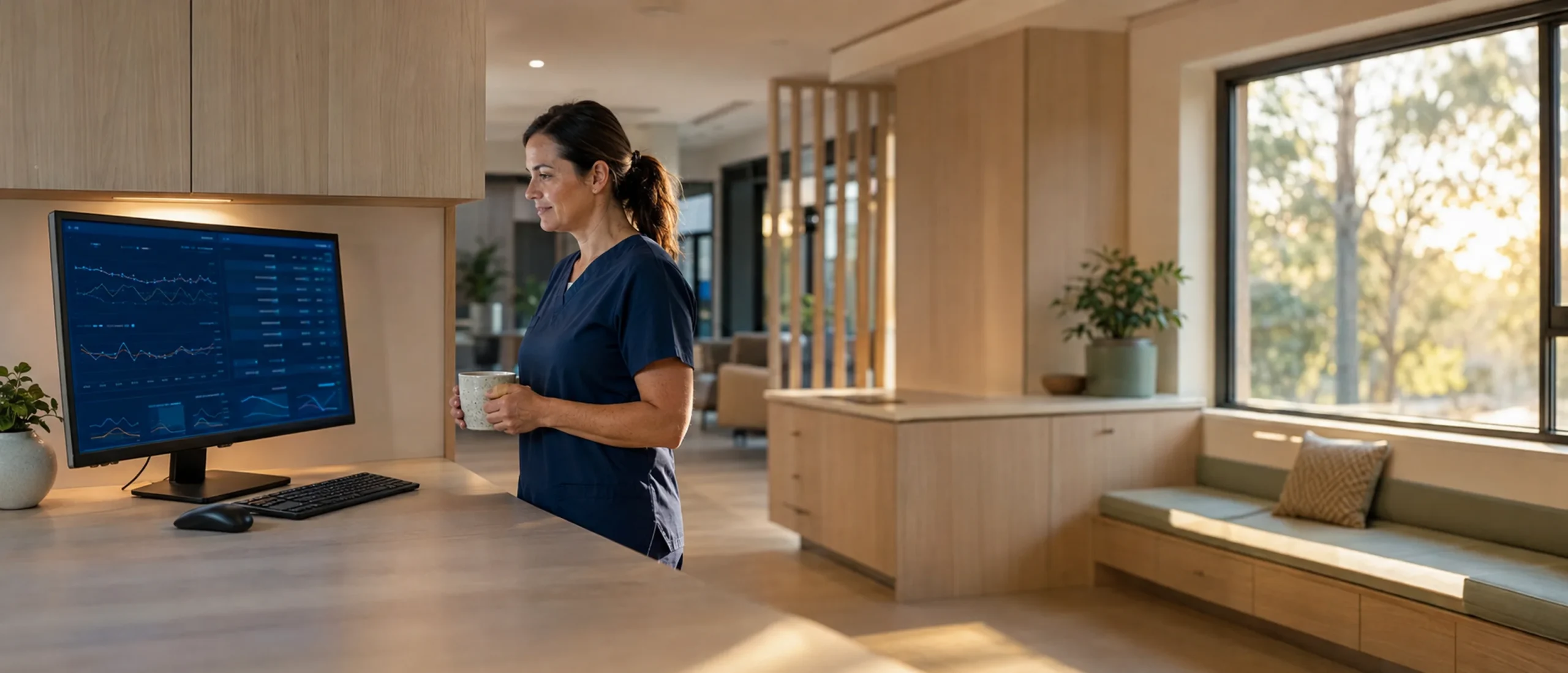
The dashboard at handover. Overnight the sensors gathered around 6,000 readings for each resident, so the morning starts with a short list of who to look at rather than a full round.
One platform, seven capabilities
The same contactless radar carries all of them. Which one leads depends on where it is deployed: predictive care in residential aged care, rapid deterioration in hospitals, acute event detection in corrections.
Leads with
Predictive Care
The POBC signal flags physiological drift ahead of clinical presentation, so the team intervenes in the trend rather than the crisis.
-
Rapid Deterioration
Continuous heart rate, respiratory rate and movement monitoring shows drift alongside your existing track-and-trigger workflows, giving the clinical team a wider window to assess and act on patient deterioration.
-
Acute Event Detection
Threshold-based alerts for acute events including tachycardia, bradycardia and respiratory distress, with movement context to cut false alarms. Thresholds are configurable per device.
-
Proof of Life
Continuous presence and physiology in every monitored room, so a non-responsive event can be raised in a way a camera or a wearable does not.
-
Clinical Evidence Trail
Time-stamped physiology for every person, building a defensible record for clinical governance in aged care, for the aged care quality indicators, for SIRS reporting including Priority 1 timeframes, and for accreditation and post-incident analysis.
-
Patient Wellness
A per-person wellbeing baseline covering sleep, agitation and restlessness. Continuous observation sits underneath the rounds, so a round can start with who to look at, and that is where registered nurse hours come back.
-
Occupancy
Real-time presence and movement supporting muster, headcount accuracy and after-hours staffing models. An operational use of presence data, not a medical-device function.
A dignity-first approach
Contactless radar measures physiology and produces no image of a person. No cameras in the room. No wearables to remember, charge or refuse. People live as they always have, while the monitoring runs quietly in the background and the clinical team gets the signal.
The evidence
-
A residential aged care reference site
A 160-bed home, live since January 2026.
-
Australian government deployments
A state corrective services agency has run it since July 2022, beginning in a maximum-security high-risk pod. Two police agencies began trials in late 2025. Each agency passed its own procurement, security and clinical governance review.
-
Independently validated
The Validation Institute awarded health outcomes validation to the POBC score in 2024: 201 monitored residents against 2,525 controls, in which POBC predicted 75.6% of hospital transfers up to seven days ahead. The cohort was a United States skilled nursing facility; it was not Australian aged care.
-
Recognised
TIME Best Inventions 2024, a Red Dot design award and a CES Innovation Award. The Validation Institute also attaches a US$100,000 credibility guarantee to the claims it validates.
-
Peer-reviewed measurement
Scientific Reports, December 2021. Fifty cardiology clinic patients, measured against ECG and capnometry at the same time as the radar. The paper reports the agreement for each measure and the conditions under which accuracy falls. Full citation on request.
What the signal came before
POBC does not identify conditions. It flags a person whose physiology has moved away from their own baseline. Where the outcome was recorded afterwards, this is how often the signal came first.
| What followed | Flagged beforehand | Lead time |
|---|---|---|
| End of life | 79.5% | 5.4 days |
Xandar Kardian platform data, vendor-reported, from a prospective study of 338 patient journeys. This is a detection rate in a cohort where the outcome was already known. It is not diagnostic accuracy, and it does not say how often the signal appears with nothing following it, which is the question a proof of value on your own floor is there to answer.
How it starts
Three stages, each with a decision point, and the rollout is the last of them.
-
Proof of concept
Around five rooms for 90 days. Opex sized, so there is no capital business case to write. It proves the POBC signal on your own residents with your own clinical team.
-
Proof of value
Twenty-five rooms over a quarter, designed with your clinical lead. It quantifies the registered nurse hours returned and the hospital transfers avoided, and builds the business case in your numbers.
-
Deployment
Once the proof of value is signed off, we scale across your sites, with the evidence framework, training and clinical workflow already proven on your floor.
See it on your floor
Where deterioration is found late, it is found in the same places: the night transfers, the falls that followed a quiet decline, the checks that miss what happens between them. Book a 30-minute executive briefing, or scope a proof of value at one of your highest-acuity sites. We bring the clinical evidence framework, the reference site and the architecture pack, so your governance committee has everything on day one instead of month three.
Book a briefing