
Distributed antenna system design and installation
From one dead zone to a whole campus
Coverage Plus takes the mobile signal that already exists outside your building and delivers it, cleanly and legally, into the basements, lifts, wards, carparks and plant rooms where phones currently fail. Assessed, designed, installed and monitored by Ericom, on carrier-approved equipment, anywhere in Australia.
Nobody logs a ticket for bad coverage
They walk outside. They stand near the window. They carry a second handset on a second network. Mobile dead zones are rarely treated as an infrastructure problem until something important depends on one: a nurse who cannot reach a duty phone from the far end of a ward, a payment terminal in a basement tenancy that times out mid transaction, an authentication code that never arrives at the moment somebody needs to log in, a lone worker in a plant room with no way to raise an alarm.
Modern buildings make it worse. Thermally efficient glazing, concrete cores and basement carparks are all very good at keeping radio out. And because mobile signal belongs to the carriers, most organisations assume it is not theirs to solve. It is, and it is solvable.
Capture, amplify, distribute
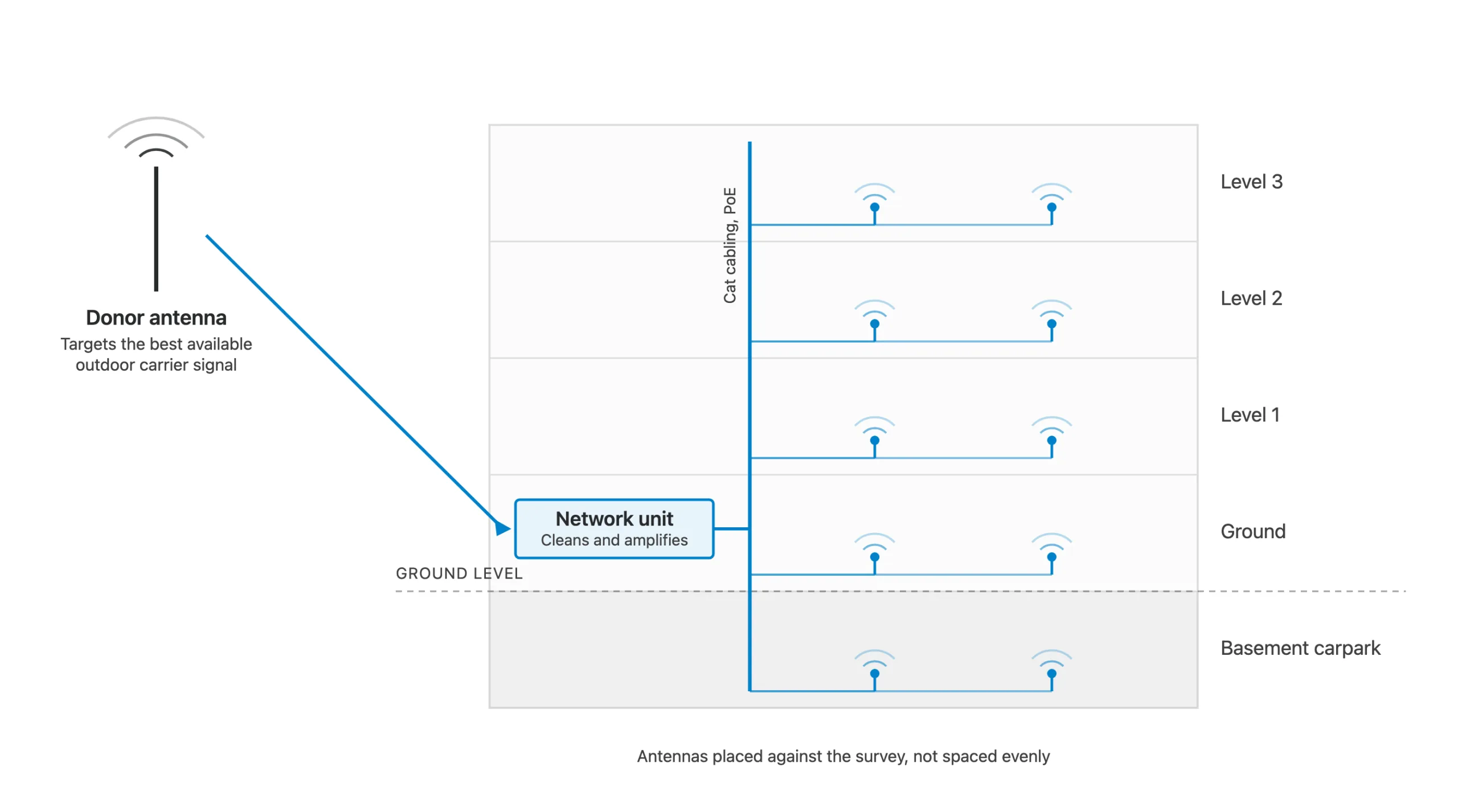
The signal your building needs is usually already outside it. The job is getting it in without degrading the network it came from.
-
Capture
A donor antenna targets the best available outdoor carrier signal, and intelligent radios lock onto the specific bands and channels each operator uses.
-
Amplify
Digital processing filters out noise and lifts each carrier's channel separately, by as much as 100 dB, while actively protecting the network from oscillation and interference.
-
Distribute
Coverage units placed through the building deliver the clean signal where it is needed, over standard category cabling carrying both signal and power.
-
Monitor
Every site reports to a cloud portal with floor-plan heatmaps and live performance data, so settings can be changed remotely without a site visit.
The distinction that matters is channel-by-channel amplification rather than blanket boosting. A basic repeater lifts everything it hears, noise included, and treats every carrier the same. This cleans each operator's signal individually and boosts each to the maximum power permitted, which is what lets one system serve several carriers at once while keeping each operator's signal within that operator's tolerances.
One dead zone, or ninety thousand square metres
The same platform scales across the whole range, so the assessment picks the smallest thing that solves the problem.
-
A single problem area
One smart repeater for one dead zone, from around twenty square metres. A meeting room, a records store, a corner of a floor. Installed inside an hour. This is a complete answer, not a trial, and it is where a lot of sites should start.
-
Several units across a floor or wing
Multiple units covering a wing, a floor or a scattered set of problem areas, commonly dual carrier so a fault on one network is less likely to take communications down with it. Typical of aged care wings and mid-sized floorplates.
-
Active distributed antenna system
Network units feeding coverage units over category cabling and Power over Ethernet. One head end feeds up to twelve coverage units, and fibre extension puts as much as two kilometres between them, which is how separated buildings, carparks and tunnels are covered from one system.
-
Full in-building coverage
Multi-operator distributed systems across large and complex sites, precincts and venues, up to ninety thousand square metres. The top of the range, and the answer for fewer sites than you would think.
Legal, and network safe by design
Boosting mobile signal is legal when the equipment is approved, and illegal when it is not. What Ericom deploys is ACMA compliant and carrier approved, and it is engineered to be network safe: it monitors its own power levels and antenna feedback continuously and cancels echo automatically, which is what keeps it inside the operator's tolerances instead of degrading the network it draws on. An unapproved booster bought online is a different thing entirely, and using one is what gets a service shut down.
How it gets delivered
Five steps, and the first one decides the other four. Nothing is specified until the site has been measured.
-
Site assessment
What the site actually receives, how each carrier performs across it, where coverage fails and why, and the optimal equipment placement.
-
Installation planning
A project timeline built around your operations, so a working building keeps working while it goes in.
-
Deployment
Certified engineers install the coverage units and antennas, validating performance in real time as it goes in.
-
Coverage validation
Testing across every area to confirm signal strength and coverage meet what was agreed, before anyone signs anything off.
-
Portal onboarding
The site joins the management portal for 24/7 monitoring, with your staff trained on it and support established.
Where a distributed antenna system fits
A distributed antenna system distributes mobile signal through a network of antennas placed across a building, so coverage reaches floors, basements, carparks and lifts that an external tower cannot serve. DAS stands for distributed antenna system, and it is the standard answer for multi-level buildings, hospitals, universities and major facilities.
What has changed is how one gets built. A traditional DAS distributes over dedicated coaxial infrastructure and takes months. An active DAS carries signal and power over standard category cabling instead, which removes most of the structured cabling work and is why larger systems now go in within days. It is one pathway among several, and most sites are better served below it.
The pathways an assessment chooses between
There is no single right answer to a coverage problem, which is why the assessment comes before the design.
Leads with
Carrier signal enhancement
Uses the carrier signal already available around the site and redistributes it into the weak areas. The most common answer, and the one that suits most sites.
-
Dedicated carrier connectivity
Connects into carrier-grade pathways where performance, capacity or resilience requirements are higher than the surrounding network can meet.
-
Distributed antenna systems
Signal distributed through antennas across buildings, floors, basements, carparks and campuses. Multi-level buildings, hospitals, universities and major facilities.
-
Multi-carrier coverage
Up to four mobile network operators served simultaneously from the same infrastructure, so a mixed-carrier workplace does not need separate equipment per network.
-
Private network readiness
Infrastructure designed with a pathway towards private 5G and IoT growth, so today's installation is not the reason you cannot do something in five years.
Three ways to buy it
Coverage infrastructure outlives most technology purchases, so how it is owned matters as much as what it costs. All three include design, deployment and support.
-
CAPEX
Own the infrastructure outright, with Ericom providing design, deployment and ongoing support.
- Long-term owned facilities
- Campuses and hospitals
- Government and owner-operated assets
- Where the asset sits on your balance sheet
-
OPEX
Take it as a managed monthly service, with design, deployment, monitoring, support and lifecycle management included.
- Predictable operating cost
- Reduced upfront spend
- Leased or shorter-tenure sites
- Where capital approval is the obstacle
-
Hybrid
Own some of it and take the rest as a service, blended to suit the project, the risk profile and the operating model.
- Multiple locations at different stages
- Staged rollouts
- Mixed owned and leased portfolios
Where it gets deployed
What these sites have in common is the building: wherever people, safety or transactions depend on a network the structure itself is blocking.
-
Healthcare and aged care
Hospitals, clinics, residential aged care and retirement living, where a nurse who cannot be reached is a clinical incident rather than an inconvenience. Recent work includes a state public health service.
-
Government and councils
Council buildings, government facilities and public spaces. Recent work includes a council rollout across multiple buildings, and a town hall carpark.
-
Education, offices and campuses
Multi-building sites with decades of construction methods on one campus, and a duty of care to visitors who did not choose to be there.
-
Industrial, logistics and transport
Warehouses, plant rooms, depots and construction sites, where payments, stock systems and safety all ride on the mobile network. Recent work includes a rail manufacturer.
Questions building owners ask
Short answers first.
Is boosting mobile signal actually legal?
Yes, when the equipment is approved. What Ericom deploys is ACMA compliant and carrier approved for use in Australia, and it is engineered to be network safe: it monitors its own power levels and antenna feedback and cancels echo automatically, which keeps it inside the operator's tolerances. Unapproved boosters bought online are a different matter, and using one is what gets services shut down.
Will it work across all of our carriers?
A single system can carry up to four mobile network operators at once from the same infrastructure, so a mixed fleet does not need separate equipment for each carrier. Most designs are specified around the carriers your people actually use.
How long does installation take?
Days. A single coverage unit goes in within the hour, and larger systems are installed, commissioned and activated inside days. The saving comes from the architecture: signal and power travel over standard network cabling, so there is far less structured cabling work to do than a traditional distributed antenna system requires.
How large a site can you cover?
From a single problem area of around twenty square metres up to sites of ninety thousand square metres. One head end feeds up to twelve coverage units, and fibre extension puts as much as two kilometres between the head end and a coverage unit, which is how separated buildings, carparks and tunnels are covered from one system.
What if there is no usable signal outside the building?
Then signal enhancement is the wrong pathway, and the assessment will say so instead of selling you one anyway. Where there is nothing usable to capture, the design moves towards dedicated carrier connectivity or a private network pathway. That judgement is the whole reason the assessment comes first.
Is this just a DAS?
A distributed antenna system is one of the pathways Coverage Plus can use, not the whole product. Active DAS sits at the top of the range for large and complex buildings. Below it sit multi-unit and single-unit deployments that solve smaller, localised problems for a fraction of the cost, and most sites are better served there.
Does it improve data as well as calls?
Yes. Coverage lifts voice, SMS and data together, which is why the business case is usually written around applications, with dropped calls a long way down the list. Mobile authentication, payment terminals, clinical systems and field safety apps all depend on the same signal.
What happens after installation?
The site is onboarded into the management portal and monitored around the clock. You get visibility of coverage performance, heatmaps against your floor plans, and an alert when performance drops below what was validated at commissioning. Ericom can adjust the system remotely as the building changes.
Do we own the system or rent it?
Either. Coverage Plus can be delivered as a capital purchase you own outright, as a managed monthly service covering design, deployment, monitoring and lifecycle management, or as a hybrid where you own the infrastructure and buy the monitoring and support as a service.
Book a coverage assessment
An Ericom specialist measures what your site receives, identifies where and why coverage fails, and gives you a design and a cost sized to the problem.
Request a coverage assessment